Tuesday Guest Feature – Geoff Parkes

Geoff Parkes

Hi Geoff, thank you for agreeing to take part in my Tuesday Blog Feature. Anyone that knows Geoff will immediately think about ‘grammar’. However, today he’s come along  to chat about his ‘Five joys of the English Language’.

Without further ado let’s go over to Geoff. 

11115586_1382194878776892_3252039807928616193_n

Five Joys of the English Language

by

Geoff Parkes

It was clear from an early age that my career would centre on English Language. In a school class of 28, I routinely came twenty-eighth in physics and first in English. Here are five aspects of English that have brought me particular joy.

  1. Reading

Though I have always loved reading, my reading habits have changed. I used to read novels and plays, but now I also read a lot of poetry and biographies of those I admire, like Laurie Lee, Mary Wesley, and Kenneth Tynan. I enjoy reading vastly different books on the same day: it’s like riding a toboggan in the morning, a camel in the afternoon, and a Ferris wheel in the evening.

  1. Writing

As with reading, this has changed. I was a journalist on the university newspaper. Next came years of writing English as Foreign Language (EFL) books. Recently I have switched mainly to novels, short stories, poems, and short plays, and I’ve dabbled with life writing. There’s huge cross-pollination: writing poetry makes prose more intense; writing plays sharpens up the dialogue in novels. I love the discipline of trying to create something that has form and meaning and is beautiful to listen to. For me, sound, rhythm and metre are important.

  1. Teaching

More than 80% of my working life has been spent teaching English. It’s a joy to deal every day with topics you love, and it’s especially pleasurable when motivated students ask intelligent questions. Never a week went by without me having to look things up which students had queried in class. I’m grateful to them for broadening my horizons.

  1. Publishing

Teaching is immensely rewarding, but there is one thing missing: an end product. After a course, you wave goodbye to students with a warm glow of satisfaction yet have nothing to show for it but memories. I will never forget the moment when I first held a book that I had produced. Yes! The fruits of three years’ labour nestled in my palm. It’s the same feeling you have if you’re a potter, an artist, or a cabinet maker. You treasure that object for years.

  1. Research

The three main prongs of English Language – grammar, vocabulary, and pronunciation – are equally fascinating, and I have done research into all three. As a student, I analysed the language of advertising. In the eighties, I became fascinated with the 300-odd words that have alternative pronunciations – scone, cervical, controversy, zebra, etc. – and set out to discover (by recording people) which were the number one variants. Nobody had ever done that. Later, I did a frequency count of English colloquial idioms.

Once you have been bitten by the research bug, it never leaves you. The more specialised the topic, the less likely it is that anyone has trodden that path before. You are a pioneer entering a vast rain forest, and you may well stumble across a purple-and-orange butterfly that no one else has seen.

Yes, these are my five main joys. All have enriched my life, but if you ask me to single one out, it is research that has given me the biggest buzz.

Many thanks, Trish, for inviting me on your blog.

My pleasure, Geoff. I’ve loved reading about your five joys and confident that my readers will do. I love your quote ‘You are a pioneer entering a vast rain forest…’ I hope you visit again in the future.

*

More about Geoff.

11115586_1382194878776892_3252039807928616193_n

Geoff Parkes grew up in Hertfordshire and went to Newcastle University before completing an M.A. in English at Cardiff University. He has worked in a timber yard, a dustcart factory, and a ladies’ underwear firm. After TEFL training, he taught English in Norway, Germany, Spain and Denmark. He then founded Southampton English Language Centre and the publishing company, Englang Books.

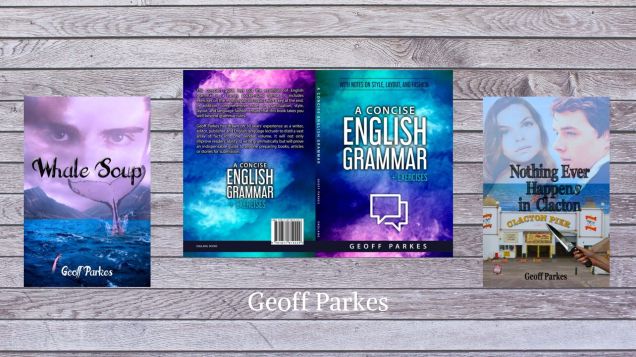
Geoff has written numerous EFL books, two novels, Whale Soup and Nothing Ever Happens in Clacton, and several prize-winning short stories. His main interests are swimming, hiking, foreign languages, and travel, especially to New Zealand, The Canary Islands, and Cuba.

*

If you’d like to know more about Geoff and his writing you can visit him on his website here. He is also available by email.

Details of all Geoff’s books may be found on his website but you may also purchase

Whale Soup and Nothing ever happens in Clacton are both available in kindle format via Amazon.

Whale Soup cvr (002)    Clacton (002)


Challenge – A story in less than 100 words

Today’s challenger is Jacqueline Taylor whose response comes in the form of Deadly Nightmare. Is it as deadly as it sounds? Read on to find out.

Deadly Nightmare

Waking up with a jolt I glanced at the clock; it read three fifteen. I wondered why Pudsey hadn’t jumped up to lick my hand. Then realised with horror I couldn’t hear my wife’s gentle snores. In fact I couldn’t even hear her breathing.

I tried to put my hand out to shake her but I couldn’t move. I must be having a nightmare. I’d wake up in a minute. I glanced at the clock again. Time had stood still.

Suddenly it came to me. Was it a nightmare or was I actually dead?

94 words

*

OOh, I think perhaps it is as deadly as it sounded. What do you think?


Words: 97.

Tuesday Guest Feature – Michelle Dunbar

Today’s special guest is, Michelle Dunbar, a talented writer and editor that I came across while studying creative writing with the Open University.

banner

Michelle has come along to tell you how she got into editing and a little about the process she goes through in her daily duties as a developmental editor, but first let’s find out a little more about our guest.

70736322_2489668127927671_5633254710019358720_n (2)

Michelle Dunbar lives on the outskirts of Glasgow with her husband, two sons, and two dogs. She is an avid reader, writer, and editor of science fiction and fantasy and is currently working on her first novel. She enjoys films and Netflix dramas in her favourite genres, and if she has the time, some gardening and baking.

*

And now over to Michelle with her article ‘Life as a Developmental Editor’.

education-3318158_1280


Life as a Developmental Editor

Michelle Dunbar

I am a developmental editor of science fiction and fantasy. I read early drafts of books and provide authors with feedback regarding the ‘bigger’ picture: Plot, story, tone, characterisation, and settings are just a few of the things I look for and give advice on.

I fell into editing through a chance tweet by an independent publisher. I had just finished studying the Advanced Creative Writing module with the Open University when the publisher, who is, sadly, no longer trading, invited me to apply to their internship as an acquisition editor. Over the course of a year, I read submissions and selected which books I felt had merit. I also had the opportunity to do some substantive and copy editing on a couple of books scheduled for publication.

I was no stranger to providing fellow authors with feedback and advice as I used to read books authors intended to send off to agents and publishers (beta reading) in the days before self-publishing became accessible to independent authors. So, after completing my English Literature degree in 2016, I started my own business.  I chose to specialize in developmental editing because structure and the different elements that go into creating a story is what interests me, and the reason I chose to specialise in science fiction and fantasy is because I wanted to increase my knowledge of common tropes and trends, with a view to helping the authors writing in these genres as much as possible.

It is important to enjoy the genres I edit in because I read each book a minimum of two, but usually three times. My first read is as a reader to gauge my initial thoughts on the story and characters. The second time I read it, I don my editor ‘hat’ and critique areas of weakness and offer praise where a scene or character works particularly well. Once this part of the process is complete, the author receives their manuscript back and makes any changes in relation to the feedback received before sending it back for a final ‘read through’, along with any questions or concerns they might have.

One of the most enjoyable parts of my job is watching a story develop from an early draft to a polished manuscript. Over the past four years, I have edited over one hundred and forty books, most of which are self-published, and now work alongside two copy editors, an additional developmental editor, and a cover designer. Just recently, I created a writing group on Facebook, with the intention of helping new writers to improve their craft. Despite my experience and current knowledge of writing techniques, I am a strong believer in professional development. I take courses on editing and devour books on the craft of writing, and I am about to commence my first year studying an MA in Creative Writing.

As for the future, I shall continue to assist authors where I can, and hope to publish my first novel in the not-too-distant future.

*

Thank you, Michelle. A very informative article. Good luck with the MA, if you enjoy it even half as much as I enjoyed mine, then you’re going to love it. Where can my readers find you?

Website 

Company Website

Facebook

Twitter

Facebook Group

Examples of books that Michelle has edited.

Untitled design (24)


Challenge – Write a story in less than 100 words

Today’s challenger to write a story in less than 100 words is writer Marian Shalloe. Marian’s response comes in the form of Rainbow’s End which may be read below.

Rainbow's End


As a child I read fairy stories to escape the harsh reality of my existence, I believed in leprechauns who kept a pot of gold at the end of every rainbow in Ireland.

One summer on my uncle’s farm, I saw a beautiful rainbow stretch across the land and set off on an adventure alone over the lush green fields to follow it. Then the Irish rain came down hard, the rainbow disappeared and I became lost.

Eventually, when found, I was punished for running off and so at such a tender age any spontaneity was curtailed.

97 words

*

What a sad little story, Marian.

If you’d like to know more about Marian and her writing you can find her here on Facebook


What inspired me to write House of Grace?

kindle unlimited

Today, I thought I’d share how House of Grace was born.  In 2013 I was finishing my BA degree with the Open University with the hopes of becoming a primary school teacher but there was one particular obstacle. I didn’t have any GCSE’s as I went straight to work at fifteen to help support the family due to my father’s disability and inability to work.

So off I went to the local college and signed up for GCSE Maths and English. It was rather strange working on the GCSE English assignments while working on the advanced creative writing course with The Open University. For instance, through the degree I learnt that you avoid using anything other than ‘said’ for the characters as ‘said’ becomes invisible on the page and anything more is the author interfering with the story. However, the GCSE remit encouraged words like ‘exclaimed’ etc.

Anyway, I’m digressing. While studying for the GCSE English, I read George Orwell’s Road to Wigan Pier and one of the assignments was to write a piece of writing about ‘A Day as a Miner’ or ‘A Day as a Miner’s Wife.’ I chose the latter and once the assignment was marked I never gave it another thought. That is until…

I was writing the dissertation for my BA assignment. The life story I was working on became  too painful and I realised it wasn’t ready to be written. I panicked. What was I going to do now? I was going to fail my degree. I turned to Google searching inspiration for a story when I suddenly remembered my character, the miner’s wife. So I had a miner’s wife but needed more. I’d enjoyed watching ‘Mr Selfridge’ and in my younger days loved ‘House of Elliott’ so I allowed them to influence me. I decided Grace, my miner’s wife, wanted to become a fashion designer and own lots of big stores. However, as a daughter of titled parents, her father, Lord Granville, had other ideas. Despite being 1950, he wanted her to have an arranged marriage. As for where the miner’s wife comes into the story, well I can’t go into any more without offering spoilers.

House of Grace was therefore inspired not only by George Orwell’s Road to Wigan Pier, but television dramas Mr Selfridge and House of Elliott. It’s a riches to rags story and if you enjoy family sagas like Downton Abbey and Mr Selfridge then it’s likely you’ll enjoy House of Grace too.

House of Grace is the first part of a trilogy but all the books may also be read as standalones. ‘The Coal Miner’s Son’, Book 2 in the series is coming soon.

By the way, I never did make becoming a teacher as I discovered I needed GCSE Science too and I couldn’t face that as well as the PGCE so I opted to become a Master of Creative Writing instead.

*

For a limited period I am offering signed copies of House of Grace for a silly price of £5 plus postage and packaging via bank transfer or £5:50 plus postage and packaging via PayPal.

screen (3)

This is the perfect time to pick up a copy as The Coal Miner’s Son is coming very soon. A signed paperback makes a perfect gift. Contact me for details.

Rather read on Kindle – you can do that too. By clicking on this link.  It is £1:99 on Kindle and FREE to read if you have Kindle Unlimited.


Lady of the Woods

Hi Everyone

Due to workload commitments, my scheduled guest has had to postpone. Rather than leave the slot empty I thought I’d share ‘Lady of the Woods’, one of my favourite mythical tree poems I wrote as part of my MA dissertation.

‘Lady of the Woods’ was first published by Reach Magazine, Indigo Dreams Publishing, in November 2018. It is also included in my upcoming poetry pamphlet ‘Taxus Baccata’ by Hedgehog Poetry Press. Enjoy. Let me know what you think.

Lady of the Woods

Lady of the Woods 

She stretches towards the stars,
heart-shaped foliage dances,
airy, pendulous branches sway.

Gently I peel away
paper-thin white crusts
patterned with black crevices.

I burn the bark
under moonlight
to keep Isolde warm.

Sapphire flames mesmerise,
crackles soothe.

We inhale timbered scent,
drink clear, sweet sap
and wintergreen tea.

I spread a red sheet
onto the clay ground,

ease Isolde down,
caress her shoulders.

We take our final offering,
the promise of fertility,
gifted by the Lady of the Woods.


Challenge – Write a story in less than 100 words

Today’s challenger is Nicola Best. Nicola’s response to write a story in less than 100 words comes in the form of  Treasured Memories. I’m sure there are a lot of readers that can associate with Nicola’s story.

Treasured Memories

‘I love autumn.’ I pick up the beautiful, glossy conkers and stuff them into my pockets.

‘What are you doing?’ My husband asks.

‘They’re pretty,’ I lie.

When we get home I put my treasure hoard on the windowsill.

‘Why are you putting them there?’ He asks.

‘To keep out the spiders.’ I lie again.

It’s for the memories – my own as a child, and my sons, now both grown-up and moved away.

Playing conkers –

Playing happy families-

Now just the two of us – leaving an empty nest.

Still, there’s always the dog.


96 words

*

What a lovely story.  What do you think?


Guest Feature – Author, Anita Hunt, MA

My Tuesday guest today is not only a great friend but also a great writer. I believe Anita has come up with something quite unique to help adults with learning disabilities.

Anita’s come along today to talk about it.

'Adults with learning disabilities'

The Memory Sessions series for Adults with Cognitive Disorders.

Anita Hunt MA

For about twenty years I have worked in the care sector. In that time, I have worked with just about every form of physical and mental disability there is. They have all been challenging, they have all been rewarding and they have all taken a little piece of my heart.

For the last eleven of those years I have been pretty firmly ensconced within the sphere called ‘adults with learning disabilities’ and even from the outset I was shocked by how little resources were available for this sector of our society.

How did I find this out?

Because one day, I went looking for something that was appropriate for their needs that we could use for reminiscence and memory recall sessions.

 Guess what?

I found nothing. Nil. Nada. Absolutely zilch of anything that was on the quiz front that wasn’t either aimed at children or at those with the brains of Mensa graduates. Ok, I may be exaggerating a little on that last bit, but not by much. There certainly wasn’t anything in the four line stanza ‘what am I?’ poems that I was looking for, or a suitable quiz that would back up the poems and give the participants an ‘easy win’ that would enable them to feel successful and feel they’d achieved something. Empowerment and self-confidence are all any of us wish for, why should it be any different for those that need just a little bit of help to get there?

So, what did I do?

I stopped being lazy. I am a published poet after all, and I started to write my own. The participants in our group loved them and the poems and quizzes were often asked for.

Each book has a selection of memory ‘what am I?’ poems such as this from the On the Farm book:

goat

I’m big to see and my boyfriend is scary,

He uses his horns when he sees red.

I eat hay and grass and go to the Dairy,

To give you the butter to spread on your bread.

A. Cow

Following this is a thirty-question quiz with a wide-ranging selection of questions that range in difficulty – From ‘What is a group of geese called?’ To ‘What noise do cows make?’ (the noises always bring fun to the session!)

We then have true or false questions such as: ‘Baby chickens are called puppies’ – true or false?

Next is a set of discussion points about the theme and this is followed by song lyrics and relevant song titles that can be found on social media sites for everyone to sing along. Music is brilliant for raising any mood and for bringing cohesion into a group.

Finally, there are  word search puzzles and either dot to dot or colouring pictures, depending on the book. The word searches and pictures can be photocopied for use within your own setting only.

There are currently three titles available on Amazon:

all three books


goat

On the Farm

Girafe

At the Zoo

fruit

Food and Drink 


all four

The fourth book – ‘About the sea’ – is currently being written and will be available soon.

*


Anita’s books certainly look inviting as the colouring draws the eye straight to them. What do you think? Do you know anyone that may benefit from these great books?

If you’d like to purchase any of the above books click on the links to go directly to Amazon.

*

Let’s find out a bit about Anita.

Profile

Anita Hunt lives in the middle of beautiful Cornwall and has somehow managed to acquire an MA in Creative Writing whilst working full time with adults with learning disabilities and running around after her three adult sons. She has two dogs who are appropriately nicknamed ‘fluffy butt’ (the elderly westie) and Psychopooch (the black lab x cocker spaniel). As well as writing the Memory Sessions, she is a published poet, published theatre reviewer and is writing her first novel – ‘Behind the Curtain’. She relaxes by playing with her camera or a ball of wool and by singing with the Rock Choir. When asked how she fits everything in, she shrugs her shoulders, gives you that ‘I don’t know look‘ and is heard to mutter – ‘sleep is for wimps…’

To find out more about Anita and her writing, why not pop along to her blog, Pixie Dreams, and check out further musings and random discussion points.

*

Thank you for coming along today, Anita, and sharing your book contents. If you have any questions for Anita, please leave a question here or contact Anita via one of her links below.

You can find Anita on

Website

Email

Facebook

Twitter

A story in less than 100 words

Our latest challenger to write a story in less than one hundred words is Lynn Johnson. Lynn’s response to the challenge comes in the form of The Best of the Best which you can read below. So why not pop the kettle on, make a cuppa and enjoy this coffee break read?

The Best of the Best

Life on the farm was perfect until one morning the farmer said, ‘I need to choose the best of the best for a special assignment, someone to help sell our produce.’

Sharon and Tracy were vain. Each thought they should be chosen. They argued and fought.

‘You’ll spoil your looks,’ they were warned.

The farmer couldn’t decide which to choose. Sharon looked bedraggled from the fight, so he chose Tracy. Tracy preened and beautified herself and looked magnificent.

She was first prize in the Christmas raffle.

That year the winner said his family had their best Christmas dinner ever.


99 words

*