
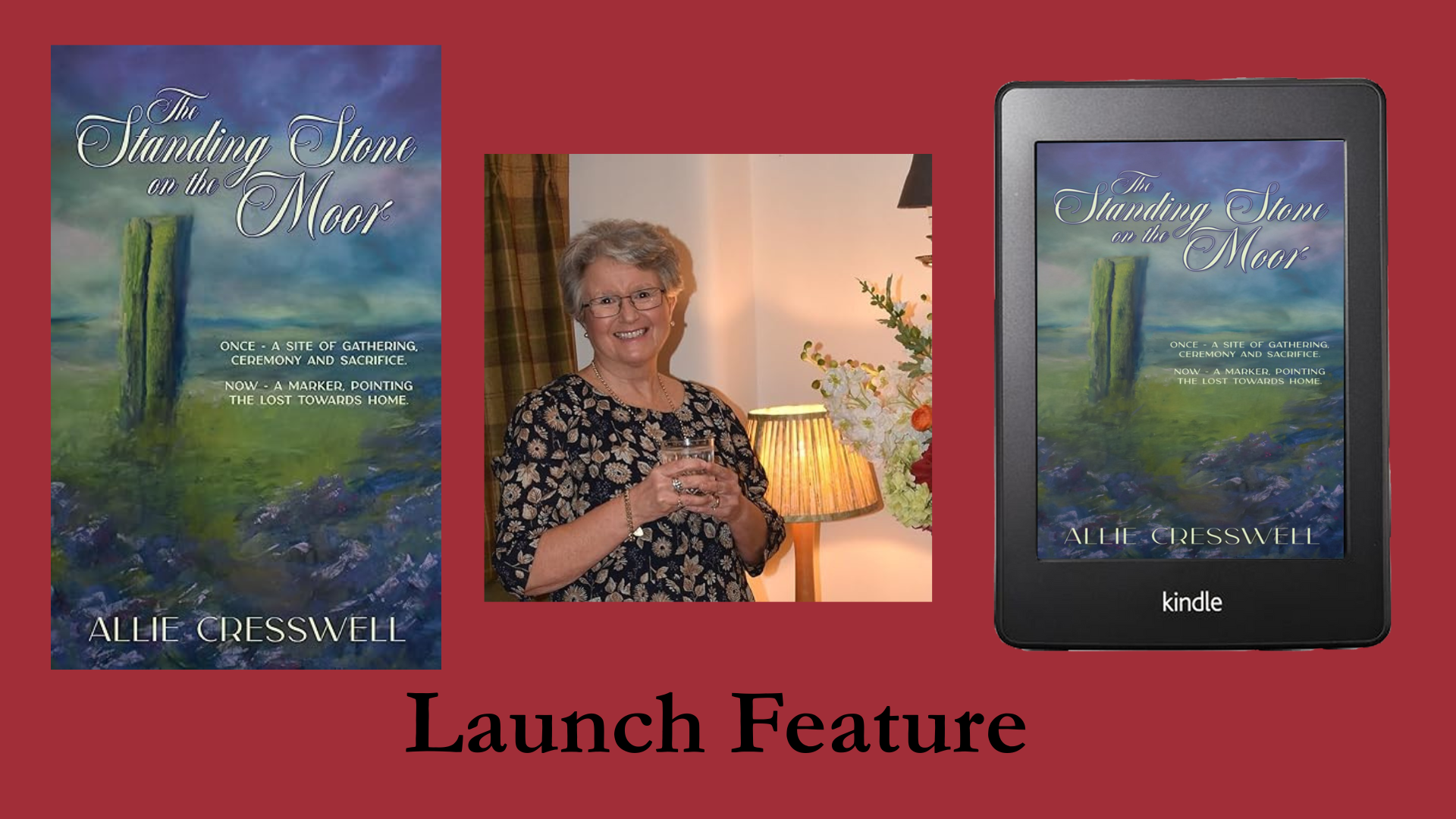
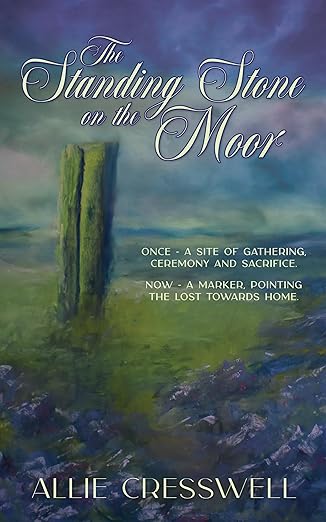
Please join me in congratulating Allie Cresswell on the launch of The Standing Stone on the Moor.
About the book
Yorkshire, 1845.
Folklore whispers that they used to burn witches at the standing stone on the moor. When the wind is easterly, it wails a strange lament. History declares it was placed as a marker, visible for miles—a signpost for the lost, directing them towards home.
Forced from their homeland by the potato famine, a group of itinerant Irish refugees sets up camp by the stone. They are met with suspicion by the locals, branded as ‘thieves and ne’er-do-wells.’ Only Beth Harlish takes pity on them, and finds herself instantly attracted to Ruairi, their charismatic leader.
Beth is the steward of nearby manor Tall Chimneys—a thankless task as the owners never visit. An educated young woman, Beth feels restless, like she doesn’t belong. But somehow ‘home’—the old house, the moor and the standing stone—exerts an uncanny magnetism. Thus Ruairi’s great sacrifice—deserting his beloved Irish homestead to save his family—resonates strongly with her.
Could she leave her home to be with him? Will he even ask her to?
As she struggles with her feelings, things take a sinister turn. The peaceable village is threatened by shrouded men crossing the moor at night, smuggling contraband from the coast. Worse, the exotic dancing of a sultry-eyed Irishwoman has local men in a feverish grip. Their womenfolk begin to mutter about spells and witchcraft. And burning.
The Irish refugees must move on, and quickly. Will Beth choose an itinerant life with Ruairi? Or will the power of ‘home’ be too strong?
What Advanced Readers Say
“An interesting tale that transports the reader back into the sometimes-brutal world of nineteenth century Yorkshire.”
“I really enjoyed my time with this book. I love the gritty classics like Wuthering Heights and anything by Catherine Cookson and those books are what this book reminded me of strongly, both in the style of writing and the events that happen on the page.”
“This is a romping good tale with pace, energy and some fantastic twists and turns.”
“The book is populated with a large cast of characters … but a couple require special mention. The first is the moor itself, sumptuously described but staying out of Bronte-land. The second background character is the house, Tall Chimneys, which seems to cast a spell over anyone who’s in contact with it.”
And here’s a teaser:-
The moor was vast and largely impassible—an expanse of black bogs, impenetrable undergrowth and dense woody swathes of small tufted shrubs. Here and there were smooth green deceptive clearings but these were sucking swamps where the unwary sank up to their necks in stinking water. Trees were few and far between, very stunted, and the whole moor—though beautiful in its wildness—was also exposed and bleak. The wind was constant, either benign—just riffling the heathers—or malevolent, a howling tearing violent thing that made men mad who were exposed to it for too long.
Lacing across the moor was a network of tracks used by carters and farmers and by those on foot crossing the heath. Some were wide enough to accommodate a cart or a carriage but dangerous to traverse at night when no light, kerbstone or other guide prevented the unwary from miring his horses up to their chests in black oozing swamp. Other pathways were suitable for foot travellers only, being narrow and meandering. It could take a lifetime to learn the secret ways, and many were the drovers and shepherds who had been lost along them. Sheep possessed a peculiar intuition that kept them from sinking in the bogs as they grazed the tracks, so the grass there was short, and in summertime threaded with innumerable small, sweet-smelling flowers that hummed with bees.
Like what you’ve read?
 Patricia M Osborne